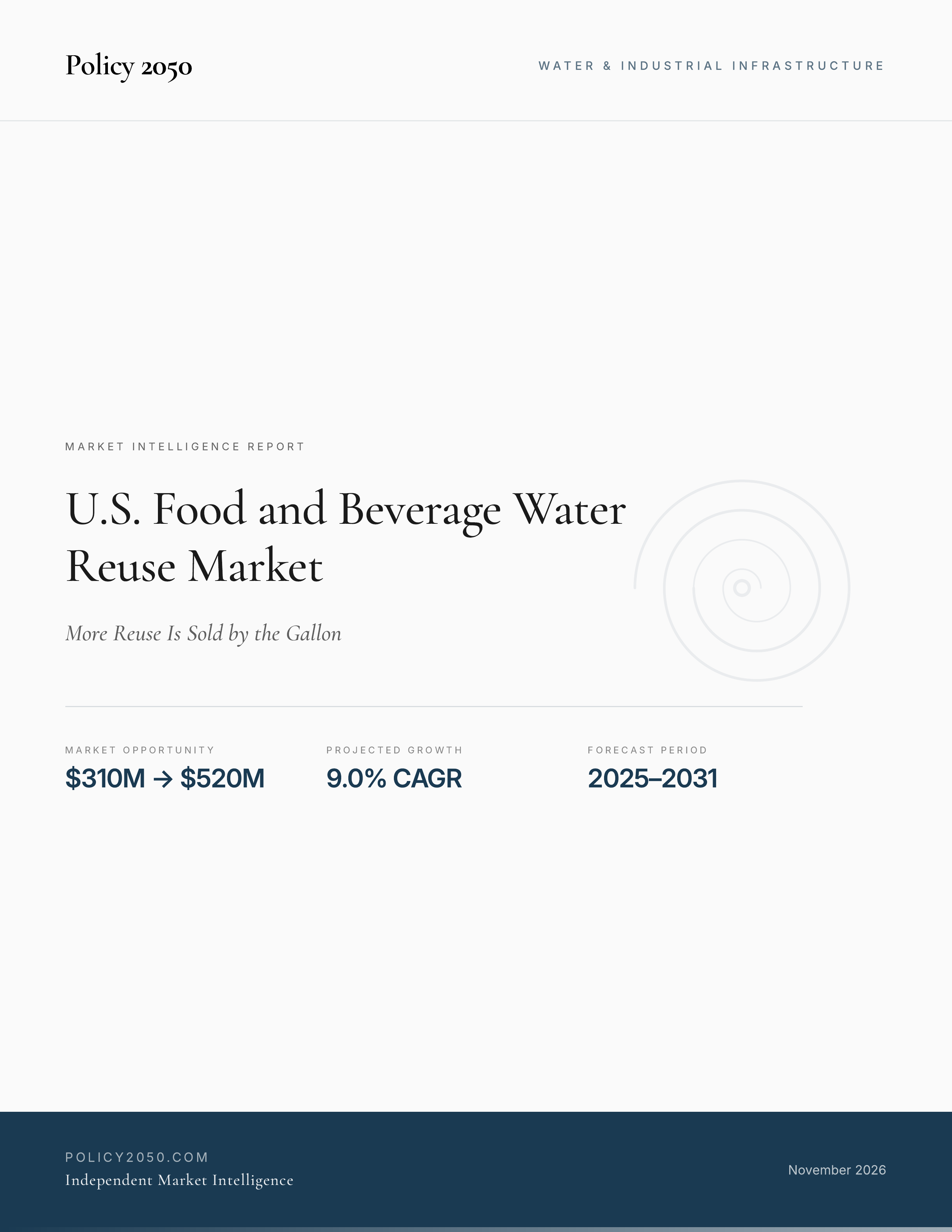
U.S. food and beverage plants spent an estimated $310 million on membrane-based water reuse in 2025, and more of them now pay an outside operator for treated water by the gallon instead of building the system themselves.
Food and beverage plants in the United States spent an estimated $310 million on membrane-based water reuse in 2025, and that spending is forecast to reach $520 million by 2031, a 9.0% compound annual growth rate. In October 2026, Ecolab took a strategic stake in ZwitterCo, a maker of membranes it describes as fouling-resistant, to bring wastewater reuse to brewing, dairy, grain and protein plants. The announced partnership pairs those membranes with Ecolab’s treatment programs, chemistry, monitoring and on-site expertise; it describes no financing. That gap matters. Cost to build and run is the main question for large membrane bioreactors, ahead of treatment efficiency. Operators such as Cambrian now finance, own and run reuse plants for processors and charge by the gallon, backed by infrastructure investors. This report finds that per-gallon reuse service, funded by infrastructure equity and bank credit, is the fastest-growing of the established ways processors buy reuse.
The report sizes the U.S. market by contract form, spend type and sub-sector, with base, conservative and optimistic forecasts. It maps the competitive landscape of equipment vendors, integrators, per-gallon operators and chemistry suppliers. Its 60 pages include 12 charts and figures, 8 data tables and profiles of 15 companies, among them Ecolab, ZwitterCo, Cambrian, Veolia, Xylem and Koch Separation Solutions.
Report Highlights:
- Reuse Bought by the Gallon: Operators such as Cambrian, backed by infrastructure capital, now finance, own and run reuse plants and bill processors by the gallon, turning a capital project into a long-term service contract. Plant-owned systems still hold most installed capacity.
- A Correctly Scoped Market: Membrane-based on-site reuse is a much smaller market than the billion-dollar-plus wastewater-recovery estimates published for the U.S. sector, because those estimates also count other recovery technologies and pretreatment. The report shows the difference and its causes.
- Segmentation by Contract Form: The market is sized three ways: by contract form (plant-owned and operated, per-gallon reuse service, chemistry-program bundle), by spend type and by sub-sector, with base, conservative and optimistic forecasts.
- The Chemistry Supplier Question: Ecolab has backed food and beverage membrane reuse through its stake in ZwitterCo, but the announced partnership includes no financing. Whether chemistry suppliers will compete with per-gallon operators or supply them is still open.
- Adoption Rests on Plant Economics: Construction costs are raising the barrier to reuse, and the federal effluent-guideline update for meat and poultry plants has been withdrawn, so adoption rests on plant economics.
- Transparent Methodology: The estimate blends a bottom-up count of water-intensive plants, built from Census and EPA facility counts, with the membrane share of published sizings, and states its confidence intervals, three scenarios and most sensitive input.
This report will provide answers to the following questions:
- How large is the U.S. market for membrane-based water reuse at food and beverage plants, and how fast will it grow through 2031?
- Why do published wastewater-recovery estimates for the U.S. sector run so far above the membrane reuse market?
- How do food and beverage plants buy water reuse: by owning the system, by paying an operator per gallon, or through a chemistry program?
- Which contract form is growing fastest, and where does its capital come from?
- What does Ecolab’s stake in ZwitterCo change, and will chemistry suppliers compete with per-gallon operators or supply them?
- How do lifecycle costs and financing shape a plant’s decision to adopt reuse?
- How is spending divided among meat and poultry, beverages, dairy and other foods?
- With the federal effluent-guideline update withdrawn, what drives and what inhibits adoption?
Companies Covered:
Ecolab, ZwitterCo, Cambrian, Revida Water, Veolia, Xylem, Koch Separation Solutions, Danaher, DuPont, Toray, Kurita, newterra, Membrion, Integrated Water Services, Veralto
Report Specifications:
60 pages · 12 charts and figures · 8 data tables · 15 company profiles · 6-year forecast horizon · 3 scenarios (base, conservative, optimistic) · 3 segmentation views
Pricing:
- Single User License – $4,950
- Site License – $5,450
- Enterprise License – $5,950
To place an order, contact david.pringmill@policy2050.com