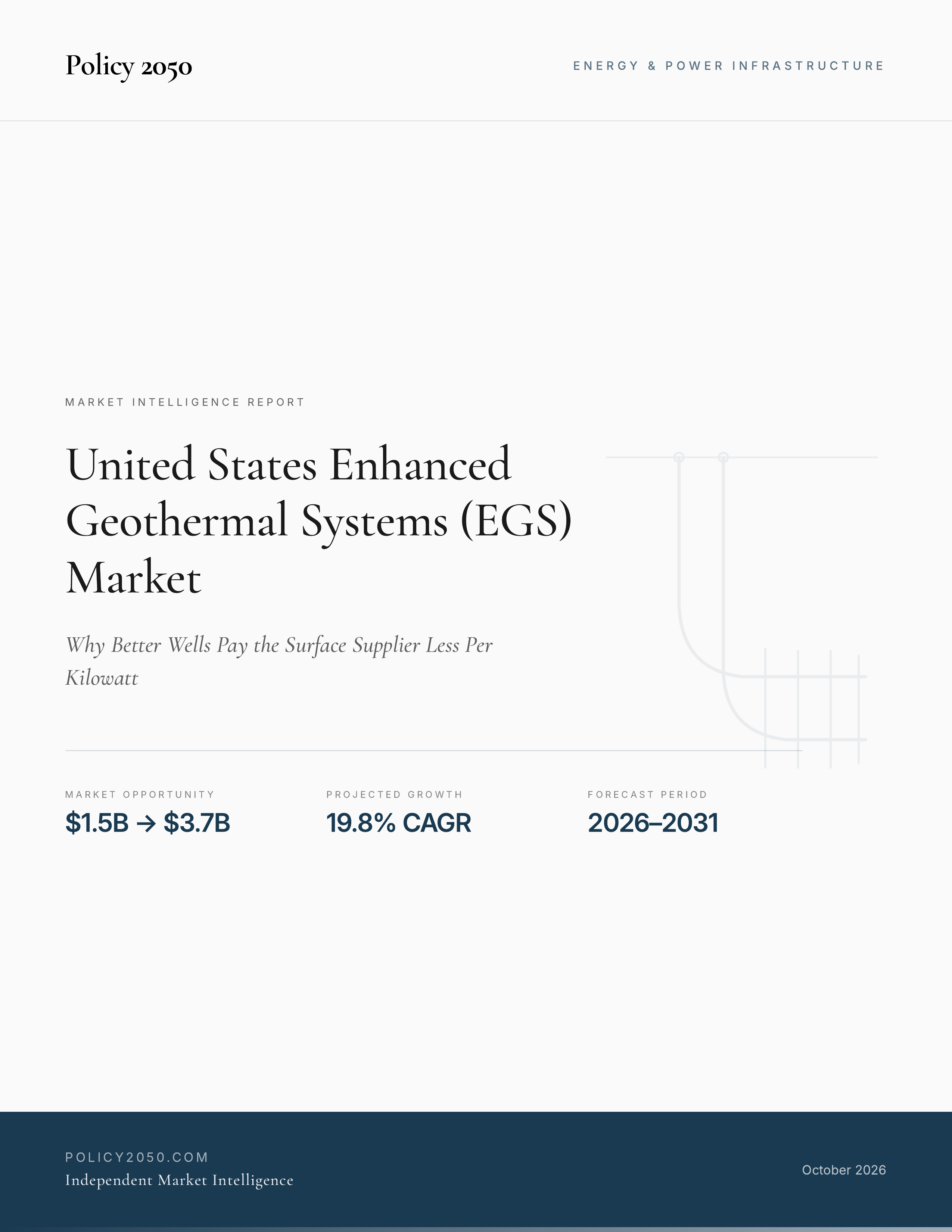
United States capital spending on next-generation geothermal power projects is estimated at about $1.5 billion in 2026 and is forecast to grow at 19.8% a year to $3.7 billion by 2031 — while buyers hold 1,054 MW of binding offtake against 6.5 MW operating today, about 162 to 1, measured at the base date.
United States capital spending on next-generation geothermal power projects is estimated at about $1.5 billion in 2026. It is forecast to grow at 19.8% a year to $3.7 billion by 2031, or at a probability-weighted 16.6% to $3.2 billion. The money is contracted years ahead of delivery. Buyers hold 1,054 MW of binding offtake with named counterparties, about 48% of it with a single buyer, against 6.5 MW operating today — about 162 to 1, measured at the base date. Binding is not delivered: an agreement can still be cancelled, downsized or renegotiated.
In August 2026 Sage Geosystems and Chiyoda Corporation opened a feasibility study on the high-pressure surface facilities a pressure-based system needs. This report sizes annual project capital expenditure for the United States alone — drilling and wells, surface plant, EPC, interconnection and development. That scope is why the figure is not comparable with the $3.40 billion and $7.428 billion values published elsewhere: the first spans direct-use heating and residential end users, and the second is a global revenue forecast running to 2035.
Every improvement in the reservoir lowers what the surface layer earns per kilowatt, so the equipment and EPC firms scaling up to serve the build carry volume exposure to a subsurface they do not control. The report runs 60 pages, with 12 charts, 8 data tables, three segmentation views, scenario forecasts with intervals, a delivery-versus-contracting matrix, and 13 company profiles — among them Fervo Energy, Ormat Technologies, Baker Hughes and Mitsubishi Heavy Industries’ Turboden.
Report Highlights:
- Contracted years ahead of delivery: Next-generation geothermal in the United States has sold its output years before it can produce it. Buyers hold 1,054 MW of binding contracted capacity against 6.5 MW operating — about 162 to 1, or about 208 to 1 counting two agreements whose binding terms are undisclosed. Both ratios are measured at the base date and compress sharply once the first 100 MW phase reaches commercial operation, and binding is not delivered: a contracted agreement can still be cancelled, downsized or renegotiated before that date. One buyer holds 511 MW of the binding total, so the demand side is about as concentrated as the supply side.
- The investable quantity, and what it is not: About $1.5 billion of United States project capital spending in 2026, growing at 19.8% a year to $3.7 billion by 2031 in the base case, or 16.6% to $3.2 billion probability-weighted. That is a different measurement from the values published elsewhere, not a smaller version of them. About four-fifths of the base-year estimate is one company’s spending, so the estimate inherits that concentration.
- Better wells make the surface supplier earn less per kilowatt: The report sizes the surface-equipment pool under three delivery scenarios and finds the surface share of capital nearly constant across all three, while the pool itself nearly doubles between the under-delivery case and a conditional ceiling case that carries a low stated probability — so supplier revenue tracks volume rather than share. The mechanism is the issuer’s own design statement that the next phase increases power output per well while reducing installed cost per kilowatt, against a first phase estimated at roughly $7,000 per kilowatt.
- Frameworks, not orders: The gigawatt-scale supply agreements behind that build are frameworks rather than purchase orders. One three-year framework covers up to 35 standardised power blocks totalling 1,750 MW, and what the supplier committed against it was reserved capacity. Power-conversion turbomachinery is made almost entirely outside the United States, though many other surface-plant components are made domestically, so foreign-entity-of-concern ownership is a commercial attribute of a supplier rather than a compliance footnote.
- A contested cost case, on a dated test: The peer-reviewed record puts the United States local experience rate at +18%, while the same study finds global geothermal costs have risen with deployment, at an experience rate of −20%. The listed developer targets $5,500 per kilowatt on the next phase and $3,000 long term. On its own cost per kilowatt the conservative scenario builds less by 2031 than the 2 GW floor of the Department of Energy’s first commercial-liftoff phase; full tax credits require construction to start by 2033.
This report will provide answers to the following questions:
- How large is United States next-generation geothermal project capital spending in the base year, and what does it become by 2031 and 2036?
- Why does that figure differ from the market values published elsewhere, and what exactly is being measured?
- How much capacity is under binding contract against how much is operating, and what would move that ratio?
- What happens to the surface-equipment pool as reservoir productivity improves?
- How does the spending divide by cost component, by technology route and by offtake route?
- Which companies hold the contracted capacity and the supply-chain positions, and what do the framework agreements actually commit?
- What would have to be true for the conservative case rather than the base case, and which policy dates bound the build?
Companies Covered:
Fervo Energy, Sage Geosystems, Ormat Technologies, Baker Hughes, Mitsubishi Heavy Industries (Turboden), Chiyoda Corporation, XGS Energy, Eavor Technologies, Quaise Energy, Zanskar, Mantle Reach Power, TOYO Engineering, GreenFire Energy
Report Specifications:
60 pages · 12 charts and figures · 8 data tables · 13 company profiles · 3 scenarios · 3 segmentation views · base year 2026 · forecast horizon 5 years featured (2031), with the 10-year figure carried (2036) · United States
Pricing:
- Single User License – $4,950
- Site License – $5,450
- Enterprise License – $5,950
To place an order, contact david.pringmill@policy2050.com