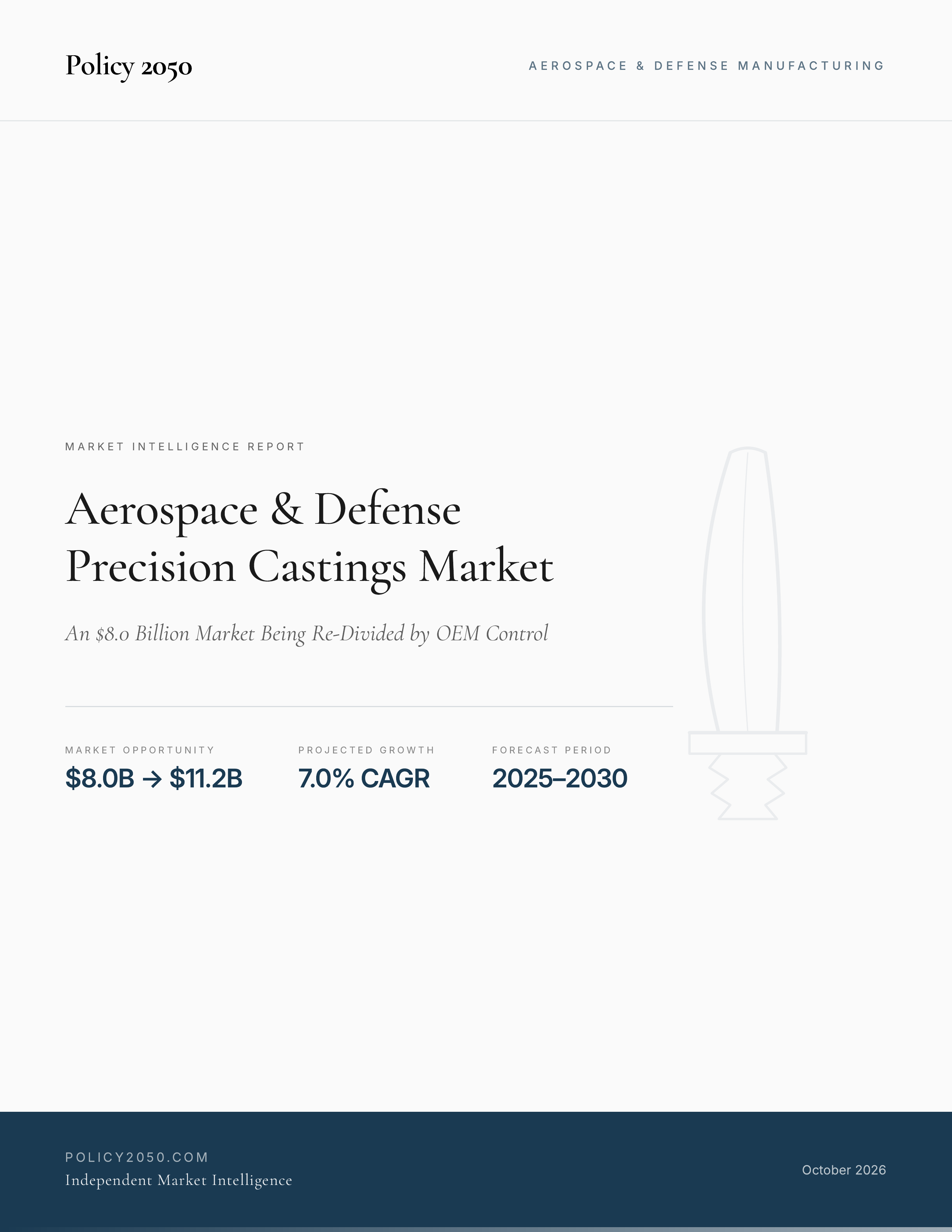
Merchant aerospace and defense precision castings revenue was about $8.0 billion in 2025 and grows to $11.2 billion by 2030 at a 7.0% CAGR in the base case, while GE Aerospace’s agreement to acquire CPP would move about one-sixth of it under engine-maker ownership at close.
Merchant suppliers of aerospace and defense precision castings earned about $8.0 billion in 2025 (modelled range $6.8–9.4 billion). In this report’s base case the market grows at a 7.0% CAGR to $11.2 billion by 2030.
On September 8, 2026, GE Aerospace agreed to acquire Consolidated Precision Products (CPP) for $11.75 billion. Close is expected in the second half of 2027, subject to regulatory approvals.
The report argues that value in this market is now set by control of yield-bounded single-crystal and directionally solidified casting capacity, not by aircraft build rates. Engine makers are buying, funding and building foundries, while gas turbines for data-centre power bid for the same capacity.
The 80-page report sizes the market by application, by end market and by ownership mode (independent and OEM-owned merchant revenue, with OEM-funded and captive capacity shown as indicators). It carries gas-turbine hot-section castings as a separate line. It profiles 12 companies, including Precision Castparts, Howmet Aerospace, CPP and Doncasters and the captive foundries of Pratt & Whitney, Rolls-Royce and Safran. It includes 20 charts and figures, 15 data tables, three forecast scenarios, a sensitivity analysis and a contraction stress test, with a forecast to 2030 and a scenario extension to 2035.
Report Highlights:
- The Price of Priority: On this report’s reading, the price GE Aerospace agreed for CPP buys priority on scarce capacity more than earnings. The $11.75 billion values CPP at about 26 times its standalone 2027 EBITDA. At close, the purchase moves about one-sixth of the $8.0 billion merchant aerospace and defense castings market under engine-maker ownership.
- Market Size and Forecast: Merchant aerospace and defense precision castings revenue was about $8.0 billion in 2025, within a modelled range of $6.8–9.4 billion. In the base case it grows to $11.2 billion by 2030, a 7.0% CAGR. The report forecasts conservative and optimistic cases beside the base case, year by year to 2030, and extends all three to 2035. Its conservative case sits close to the 3.9–4.2% that the specialist aircraft engine casting reports forecast.
- The Second Bidder: Gas turbines are a second bidder for the same foundries. Industrial gas turbine work was 42% of Doncasters’ 2025 revenue against 35% for aerospace, and 22% of Howmet’s $4.3 billion Engine Products segment. The report sizes gas-turbine hot-section castings as a separate line, from 2025 to 2030.
- An Ownership Spectrum: Engine makers are taking control of casting capacity along a spectrum, not in one step. Pratt & Whitney is expanding its Asheville turbine-airfoil plant, Rolls-Royce plans to double output at its Rotherham blade-casting facility by 2030, Safran’s Rennes turbine-blade foundry opens in 2027, and OEM capital is flowing into Doncasters, an independent, which cites up to 80% customer contribution to capital investment in its strategic partnerships.
- Airfoils, Not Airframes: The squeeze is set by airfoils, spares and gas turbines, not by airframes: Airbus described its engine supply as normalized in July 2026. In 2020, Howmet’s Engine Products and PCC’s revenues each fell by about 28–29%. The report’s contraction stress test applies a shock on that scale to the 2025 merchant pool.
This report will provide answers to the following questions:
- Who will control qualified casting capacity through 2030, and on what terms?
- How large is the merchant aerospace and defense precision castings market in 2025, and how is it forecast to grow under base, conservative and optimistic cases to 2030 and 2035?
- What does GE Aerospace’s agreement to acquire CPP price, and what could antitrust review change?
- How is merchant revenue split between independent and OEM-owned suppliers, and how far have OEM-funded and captive foundries advanced?
- How much do gas turbines for power generation compete with aerospace for the same single-crystal capacity?
- What limits casting capacity: yield, qualification or machine-tool lead times?
- How exposed is the market to a demand shock on the scale of 2020?
Companies Covered:
GE Aerospace, Consolidated Precision Products (CPP), Precision Castparts Corp., Howmet Aerospace, Doncasters (DPC Holdings), Pratt & Whitney (RTX), Rolls-Royce, Safran, GE Vernova, Siemens Energy, ATI, Rangeview
Report Specifications:
80 pages · 20 charts and figures · 15 data tables · 12 company profiles · forecast horizon 2025–2030 · 3 scenarios (base, conservative, optimistic), each extended to 2035 · 3 segmentation views
Pricing:
- Single User License – $9,950
- Site License – $10,950
- Enterprise License – $11,950
To place an order, contact david.pringmill@policy2050.com