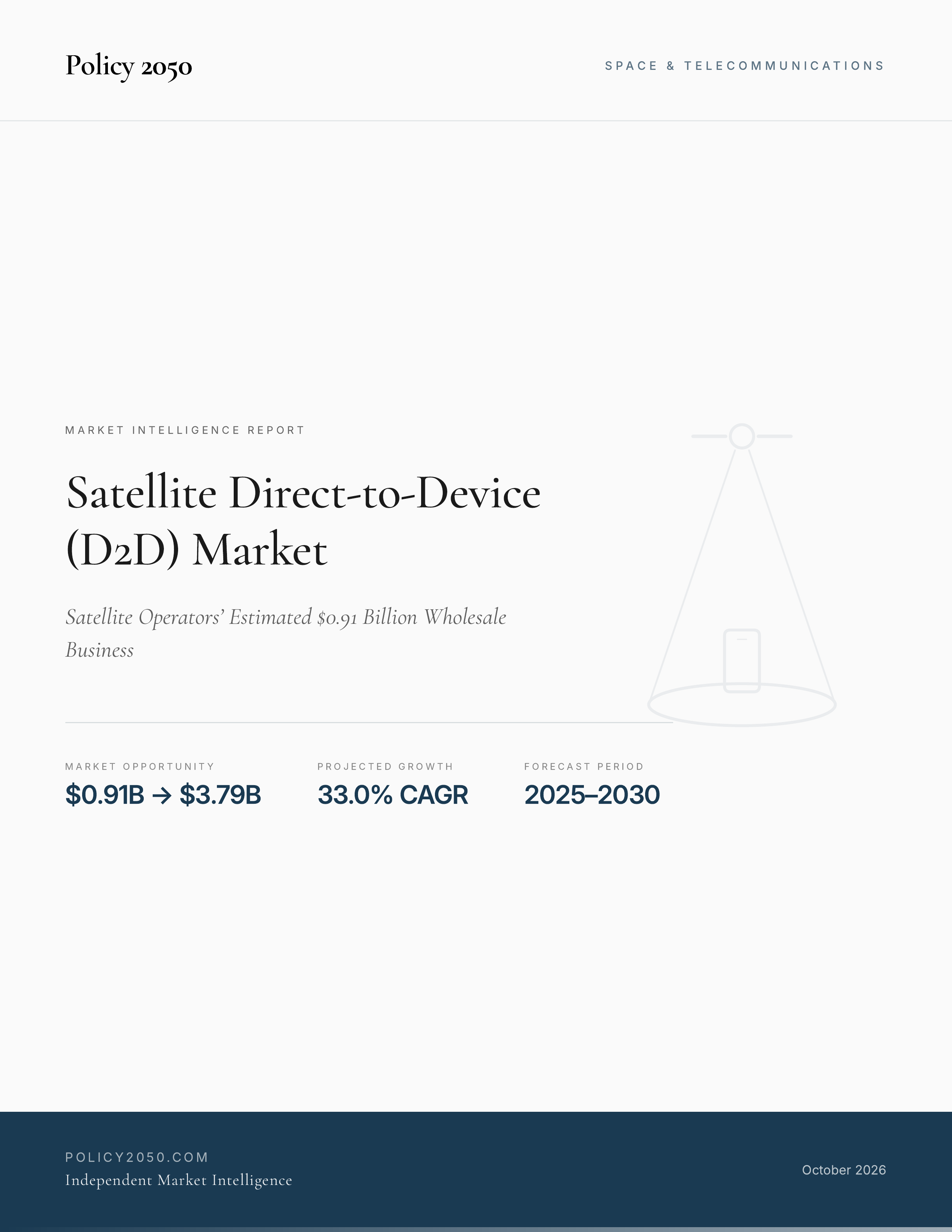
Satellite operators earned an estimated $0.91 billion from direct-to-device (D2D) connectivity in 2025, almost all of it wholesale and part of it possibly one-time, and in the base case that revenue grows at a 33.0% CAGR to $3.79 billion by 2030.
When the Federal Communications Commission licensed SpaceX on 6 October 2026 to deploy a 15,000-satellite constellation for direct-to-device (D2D) service, satellite operators had already earned an estimated $0.91 billion from D2D connectivity in 2025, almost all of it wholesale, part of it possibly one-time. The licence opens the question the next eighteen months will settle: whether that money keeps flowing wholesale, through mobile operators and device makers, or a spectrum-owning satellite operator starts selling mobile service direct. In the base case, satellite operators’ D2D revenue grows at a 33.0% CAGR from 2025 to 2030, reaching $3.79 billion by 2030. The report sets out three scenarios to 2030 around the 2027–2028 capacity step. It segments the market by revenue channel, geography and service type, maps spectrum holdings and wholesale agreements, and profiles 14 companies, including SpaceX, AST SpaceMobile, Globalstar, Amazon, Apple and the three largest U.S. carriers. The 80-page report carries 18 charts and figures and 14 data tables.
Report Highlights:
- Wholesale, Not Subscription: At the satellite-operator layer, D2D is a wholesale business, not a consumer subscription market. Of satellite operators’ estimated $0.91 billion in 2025 D2D revenue, an estimated majority came through SpaceX’s revenue-sharing agreements with mobile operators, and Globalstar reported $0.17 billion of wholesale capacity revenue from its contract with Apple. A model of users times consumer prices reproduces only a fraction of SpaceX’s estimated amount; the report sizes the named operators’ D2D revenue from their own filings and treats other providers, which disclose none, as an assumption.
- Base-Case Forecast and Three Scenarios: Satellite operators’ D2D revenue grows from an estimated $0.91 billion in 2025 to $3.79 billion by 2030 in the base case, a 33.0% CAGR for 2025–2030. The report sets out conservative, base and optimistic scenarios, with year-by-year forecasts to 2030. Published estimates for 2025 run from $0.41 billion to $4.08 billion and do not count the same things: the two highest, at $4.05 billion and $4.08 billion, include laptops and tablets among devices and Ku- and Ka-band links, while the lowest names neither.
- Three Revenue Channels: On the report’s estimates, MNO-partnered D2D, in which mobile operators pay satellite operators a revenue share or capacity fee, is the largest and fastest-growing channel. The report sizes three revenue channels (MNO-partnered, device-maker wholesale, and IoT and messaging providers) with each channel’s share of 2025 revenue and its growth rate to 2030.
- Spectrum Cost Against Today’s Revenue: The spectrum SpaceX is buying costs many times what D2D earns today. SpaceX’s purchase of EchoStar’s licences carries total consideration of about $19.6 billion, some 21 times satellite operators’ total 2025 D2D revenue. The bands also carry terrestrial rights that SpaceX says it will build out, so the price is not a valuation of D2D alone. The FCC bars commercial use of those bands until the transaction’s second step closes, expected on or about 30 November 2027. On its second-quarter 2026 earnings call, SpaceX said it expects to win customers from the three largest U.S. carriers, with service starting at the end of 2027.
- Capacity and Demand Constraints: Capacity and demand both hold growth back. A preprint measurement study of SpaceX’s SMS-only service estimates about 3 Mbps per beam outdoors for the announced data service. An analyst survey puts the revenue uplift D2D messaging gives early-adopter mobile operators at about 1% in 2026. The base case depends on next-generation capacity arriving in 2027 and 2028; a one-year delay would lower 2030 revenue, and the report quantifies by how much.
This report will provide answers to the following questions:
- How large was satellite operators’ direct-to-device revenue in 2025, and how much of it came through wholesale agreements with mobile operators and device makers?
- How fast does satellite operators’ D2D revenue grow to 2030 in the conservative, base and optimistic scenarios?
- Why do published estimates of the 2025 D2D market run from $0.41 billion to $4.08 billion, and what does each one count?
- Which revenue channel — MNO-partnered, device-maker wholesale, or IoT and messaging — is largest, and which grows fastest?
- What does SpaceX’s purchase of EchoStar’s spectrum mean for the wholesale model, and when can those bands be used commercially?
- How would a one-year delay in next-generation satellite capacity change 2030 revenue?
- How is the market segmented by geography and by service type?
Companies Covered:
SpaceX, AST SpaceMobile, Globalstar, Amazon, Apple, EchoStar, T-Mobile US, AT&T, Verizon, Skylo Technologies, Elveo Mobile, Viasat, Space42, Iridium Communications
Report Specifications:
80 pages · 18 charts and figures · 14 data tables · 14 company profiles · forecast horizon of 5 years, to 2030 · 3 scenarios · 3 segmentation views
Pricing:
- Single User License – $9,950
- Site License – $10,950
- Enterprise License – $11,950
To place an order, contact david.pringmill@policy2050.com